Bennu and the OSIRIS-REx Mission: Insights from an Ancient Asteroid
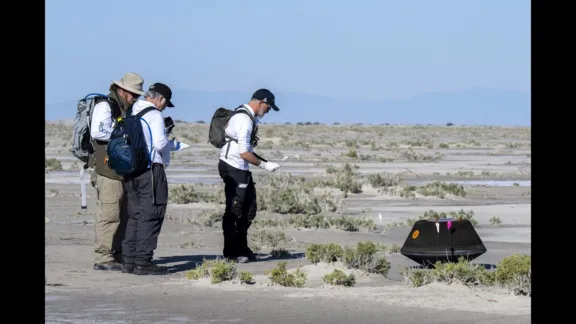
Dante Lauretta of the University of Arizona, principal investigator of NASA's OSIRIS-REx mission, explores what samples returned from asteroid Bennu reveal about primitive asteroids, water-rich minerals, organic matter and the early Solar System. More…
Analysis of Interplanetary Dust from Kuiper Belt Objects
Lindsay Keller of the NASA Johnson Space Center presents analyses of interplanetary dust particles traced to the Kuiper Belt, including hydrated grains whose secondary minerals record past aqueous activity in Kuiper Belt objects. More…
Chondrules and their importance in the early Solar System
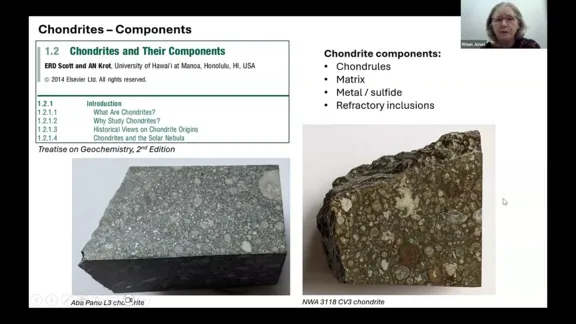
Rhian Jones of the University of Manchester reviews what we know about chondrules, the millimetre-sized beads of rock that formed in the earliest Solar System, and the question of what heated them, a puzzle that has endured for over 150 years. More…
The abundance and importance of Type 1 material in the Solar System
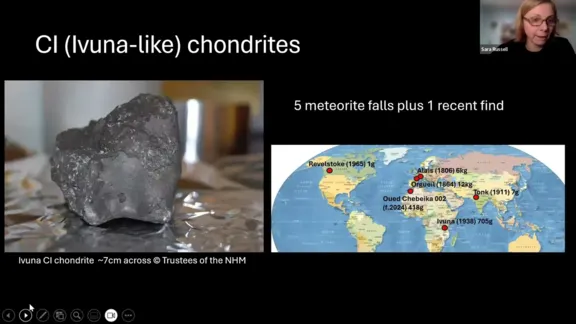
Sara Russell of the Natural History Museum, London, reviews Type 1 chondrites, heavily water-altered material rare in meteorite collections yet returned from Ryugu and Bennu, and argues it is common throughout the Solar System. More…
Short-Lived Radionuclides in Meteorites and the Sun's Birth Environment

Steve Desch of Arizona State University reviews the short-lived radionuclides recorded in meteorites and argues they were inherited from the Sun's molecular cloud, pointing to a Sun born in a spiral arm of the Galaxy. More…
Solar System Genealogy based on Isotope Anomalies in Meteorites

Christoph Burkhardt of the Max Planck Institute for Solar System Research introduces isotope anomalies in meteorites and how they trace genetic links among planetary materials, from the NC-CC dichotomy to the origin of Earth's volatiles. More…
Exploring Ryugu: Key discoveries from asteroid samples returned by Hayabusa2
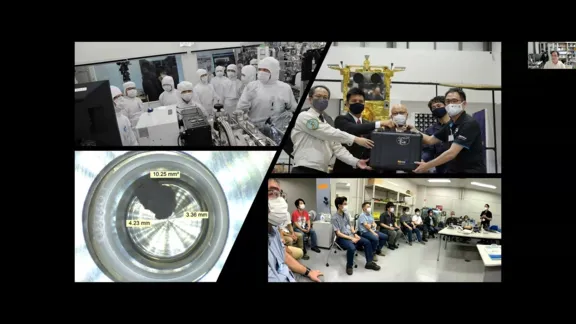
Motoo Ito of the Japan Agency for Marine-Earth Science and Technology summarizes the key discoveries from the Hayabusa2 samples of asteroid Ryugu, covering their chemistry, mineralogy, petrology, organics and space weathering. More…
The Diverse Rocky Materials that Formed Comets
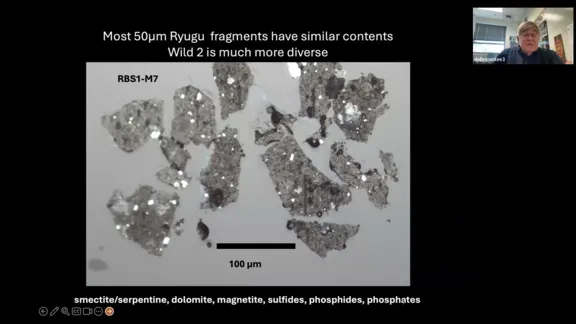
Don Brownlee of the University of Washington, principal investigator of NASA's Stardust mission, examines the rocky particles Stardust collected from an active comet and what their high-temperature origins reveal about how comets formed. More…
Achondrite Meteorites: Messengers of Early Planetary Accretion and Evolution
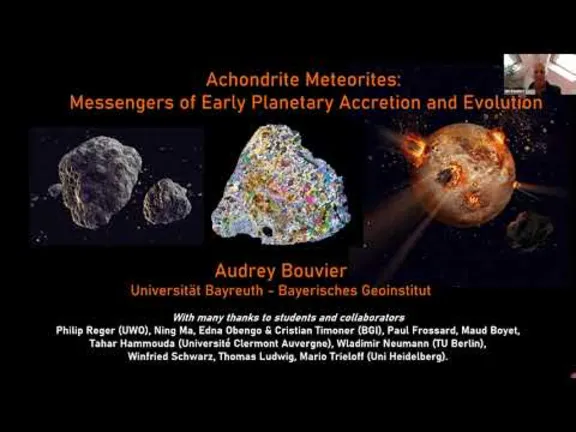
Audrey Bouvier of the University of Bayreuth surveys primitive and basaltic achondrites, what their petrology and chronology reveal about planetesimal formation and differentiation, and how they bear on the origin of the protoplanetary disk and planets. More…
Mars Sample Return: Why Martian Meteorites and Rover Missions Are Not Enough
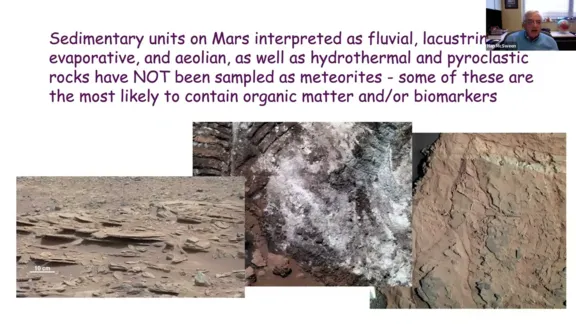
Harry "Hap" McSween of the University of Tennessee makes the case for Mars Sample Return, considering why nearly 200 martian meteorites and the rover missions are not enough to answer key questions about the geologic and possibly biologic history of Mars. More…